How WIPA Works
Model Background
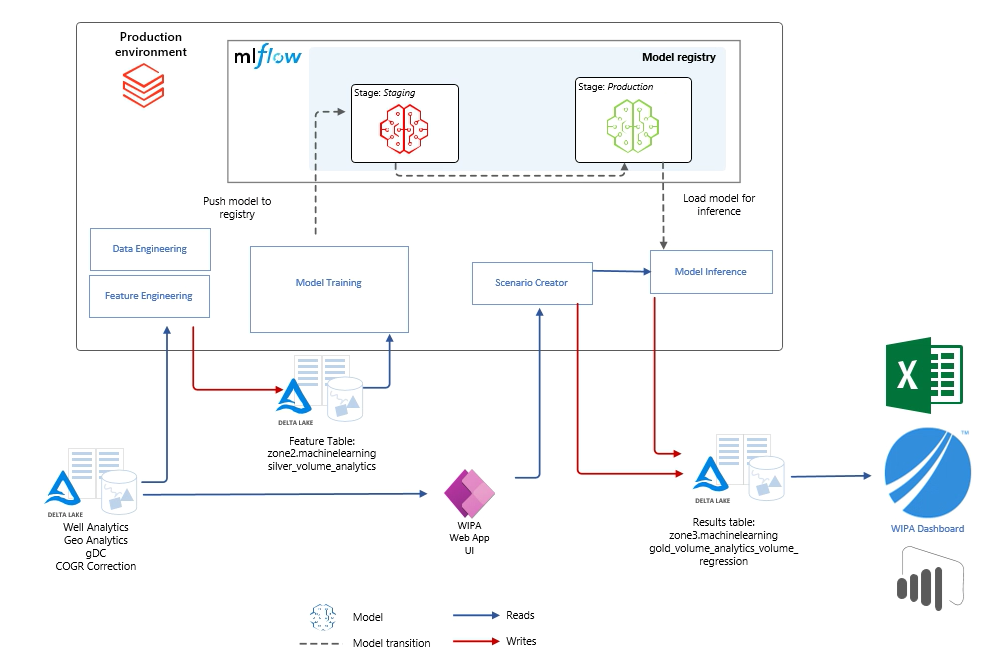
Model – Process
Model – Regions
Model Region Intro
The Volumes Regression Model is intended for gas and liquid volume predictions in the unconventional Montney fairway.
Models are Regional
Models cover the entire Montney trend (except more conventional regions with low pressure gradient and excluding Ante Creek).
These areas were removed from the model because the geological and reservoir models do not properly characterize the reservoirs in those regions.
Models utilize regional geological and reservoir grids.
In‑Situ Fluid‑Based Models
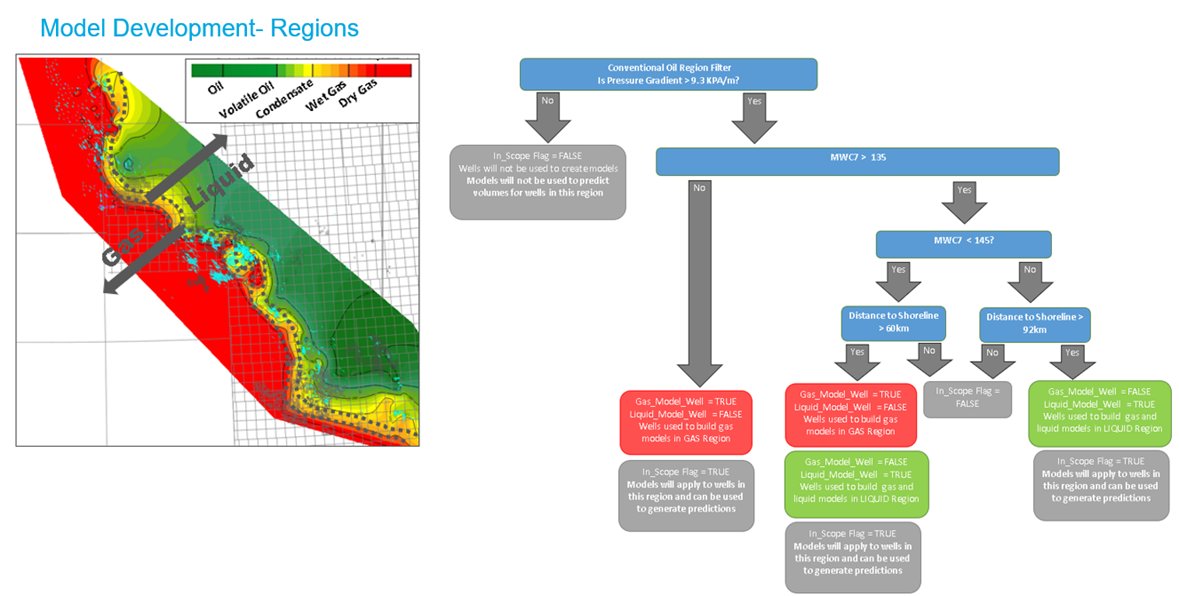
Well classification (gas vs liquids) is based on MWC7+.
- Gas region generates one model (gas volume predictions only)
- Liquid region generates two models (gas and liquids predictions)
- Region of overlap where wells belong to both gas and liquid regions
Gas and Liquid Volume Predictions
Models exist for each time interval:
- 3, 6, 12, 18, 24, 36 months
- EUR
For a total of 21 models.
Well Classification: In‑Scope vs Out‑of‑Scope
Out of Scope
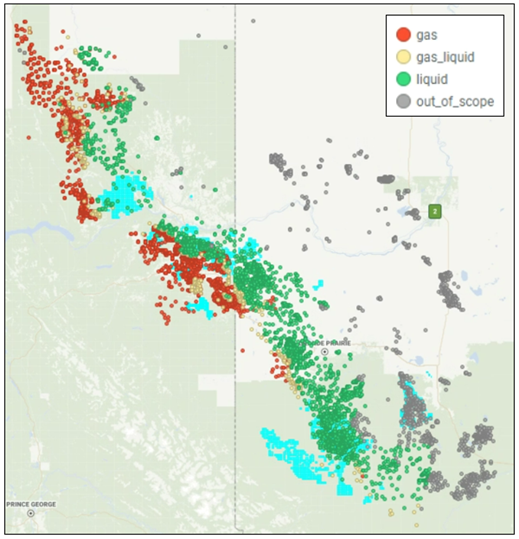
Regions that are conventional as defined by pressure gradient (kPa/m) and distance to shoreline (km) are excluded. Values are ARC Zone Specific.
- Conventional: Pressure Gradient < 9.3 kPa/m
Transition Region (Kaybob / Simonette):
- Pressure Gradient > 9.3 kPa/m AND Distance to Shoreline < 60 km AND MWC7+ < 145
- Pressure Gradient > 9.3 kPa/m AND Distance to Shoreline < 92 km AND MWC7+ > 145
In‑Scope
In‑scope wells are classified to exist in three regions:
- Gas
- Gas‑Liquid
- Liquid
Model Regions
The Volumes Regression Model is split into 2 main regions: Gas and Liquids Region.
Gas, Gas-Liquid, Liquid
Gas: MWC7+ < 135. Primary product is anticipated to be gas with minimal liquids
Gas‑Liquid: 135 < MWC7+ < 145 AND Distance to Shoreline > 60 km. This ’transition region’ is to allow better data coverage in both models as opposed to distinct gas/liquids line. Included in both gas/liquid region models
Liquid: MWC7+ > 145 AND Distance to Shoreline > 92 km. Primary product is anticipated to be liquids with secondary gas.
Well Classification: Models
Gas Region Model: In-Scope wells classified as ‘Gas’ and ‘Gas-Liquid’
Liquid Region Model: In-Scope wells classified as ‘Liquid’ and ‘Gas-Liquid’
Model - Features
Current Model Features
Prediction (3,6,12,18,24,36 month and EUR)
- Gas Model - Cumulative gas (mcf) per 100m
- Liquid Model - Cumulative gas (mcf) per 100m & Cumulative hydrocarbon liquids (bbl) per 100m
Total Features: 15
Geology/Reservoir Features
- OOIP per section (Liquid Model) & OGIP per section (Gas Model)
- POR6_OVER_POR1
- RESERVOIR PERMEABILITY (Kamath permeability nD)
- INITIAL RESERVOIR PRESSURE
- DEPLETION INDEX
- BVW
- TOC
Well Design Features
- PROPPANT PER LENGTH (T/m)
- AVERAGE DRAINAGE AREA - ADA (Ha)
- PERF CLUSTER SPACING (m)
- STAGE SPACING (m)
- PUMP RATE PER CLUSTER (m3/min - per cl)
- PROPPANT PER FLUID (T/m3)
- TMD_DIV_TVD
- ON AZIMUTH VARIATION (degrees)
Model features were updated in V9 (Q1 2025). Previous model features below
Previous model features: Geo Features (7):
OGIP per 100 or OOIP per 100, POR6_OVER_POR1, KAMATHPERM_nD, BVW, TOC, SW24PROXY,PI_ESTIMATE_DEPLETED_BEST
Design Features (7):
T_HCPV,PERF CLUSTER SPACING, STAGE SPACING, PUMPRATE PER CLUSTER, PROPPANT_PER_FLUID, TMD_DIV_TVD,ON AZIMUTH VARIATION
Response Variables
NOTE! In WIPA V8 (OCT 2024) update - the response variables were updated to be normalized (per 100m):
- 3–36mo + EUR MMCF → MMCF per 100m
- 3–36mo + EUR BBL → BBL per 100m
COGR ML was updated to include AB and BC sales volumes, improving model error from ~25% to ~5%.
The model predicts cumulative gas and liquid volumes at:
- 3, 6, 12, 18, 24, 36 months
- EUR
The volumes used to train the model are corrected as per Volumes Correction via COGR ML project:
Volumes Correction via COGR ML
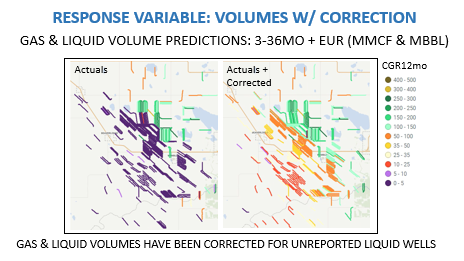
The corrected volumes dataset will include actual volumes on wells that have proper gas and liquids reporting.
Wells that do not have proper reporting will have corrections applied based on COGR prediction across 3,6,12,18,24,36mo and EUR time intervals.